Structurism
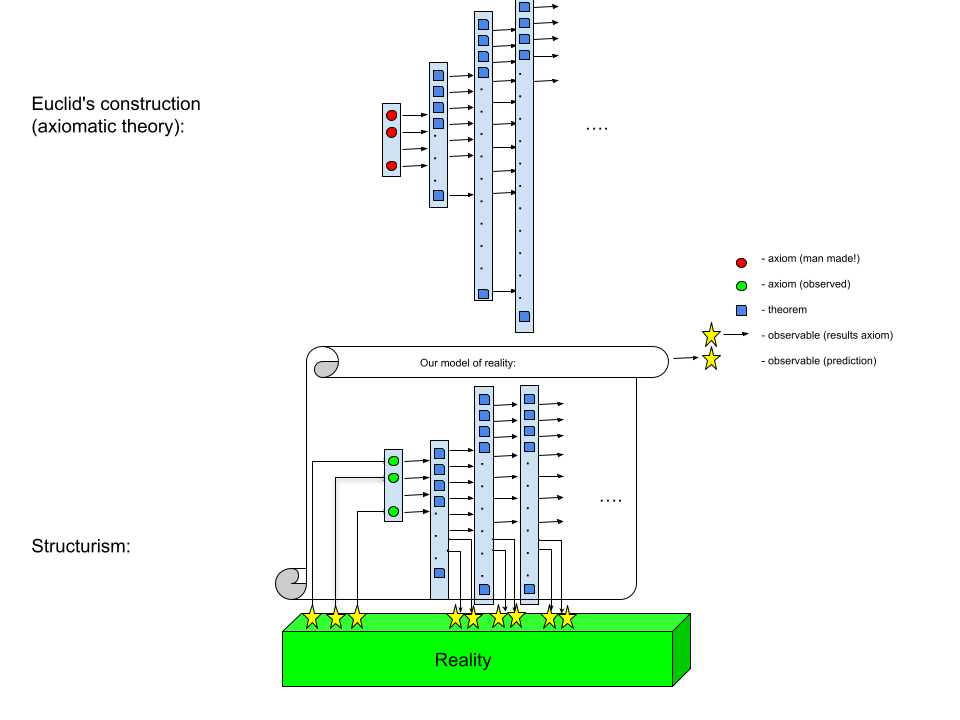 How do we build our theories? Here is the Philosophical framework to build theories in all scales.
Current Philosophical frameworks to build a model of reality are based on the Scientific Method1, which itself is built upon axiomatic structures.
Before starting, I have to mention no AI is used while I am writing my posts here.
Euclid2 constructed his famous masterpiece, the Euclid's Elements, out of an axiomatic structure, to show everyone how great it works. He assumed some axioms, then constructed some theorems upon them. So the axioms are the fundamentals of the model he built. Based on this approach, fundamentals/axioms don't need to be constructed, so they could be anything, as long as you could build on top of them without reaching into any inconsistency! In the past two millennials this idea was so successful that people submerge into it, so we build everything scientific on top of it. However, there are problems.
Problems
The first problem that has been exploited since the last century is that people assume unconstructable things as fundamentals. It becomes a loophole that you use when you cannot construct something! Therefore, you use that unconstructable things as fundamentals or axioms, so you didn't violate anything in principle! If you read my previous writings you know what my examples are: the instantaneous collapse of the wavefunction in the Quantum theories, which is not constructable, thus we assumed it as a fundamental! This problem has its own name. We call it the Measurement problem3. The set in the Set theory is not constructable too, so we put it on the foundation of the Mathematics. Here our solution must patch this problem, or at least stop future people to make such mistakes. To iterate on this problem we need to make sure our axioms are constructables, so in principle people cannot make up random stuff!
Notice, here we are not saying don't make unconstructable fundamentals. It's okay to avoid construction and call your assumption a conjecture, to postpone dealing with its construction, but don't waste people's time by pushing it as a fundamental of the nature!
Additionally, you may notice we are using computation, construction, and proof, interchangeable here. This clarifies the problem above, since any computation needs initial values on the boundary to start the computation. The axioms/fundamentals are those initial values on the boundary of our construction, thus should we take care of their construction to solve this problem? We will tackle this problem below.
The second problem is the Reductionism4, which applied the axiomatic structure to the real world's scale, which means you build stuff on top of smaller stuff. Then you pick the smallest in your model as the fundamentals. It has been shown that even the Emergence5 cannot address the problem this approach creates. The Quantum Mechanic's6 example is the Entanglement7, that can happen in a really large scale experiments. But it cannot be built upon smaller things!
Another example that usually claimed to be solved, but I don't think so, is the Van der Waals interactions8, which I associate them to some structures much bigger than molecules as you will see later, but that is not constructable in the Reductionism's approach. As a side note, I don't agree with the standard explanation of Van der Waals interactions8, since it claims asymmetry in the structure of the molecules will result in a distribution of positive and negative charges across the molecule, which is not a constructable proposition! Why don't we just avoid trying to explain it with unconstructable distribution of charges, instead, we deduce the Van der Waals interactions based on the asymmetry itself? The same for the Surface tension9, which is again is a result of the asymmetry, but in the standard explanation we involved the charges unconstructably!
Even if we take the Emergence as a fundamental, then it must not rely on the Reductionism, so the question would be: on which basis the emergent phenomenons appear? What can be accounted as an emergent phenomenon, and what could be built upon the Reductionism? Is trial and error the answer? Thus, it's an unsolved problem as described.
The third problem is the Gödel's incompleteness theorem 10. It's proven that we cannot build even all properties of the Natural numbers based on our construction of the Natural numbers, which is based on the Peano axioms11. In other words, there are some statements which cannot be proven solely based on the Peano axioms, so to have a complete model we need to have access to as many axioms in our theory as our theory tries to explain more phenomenons. This problem completely breaks down the axiomatic system of Euclid for a century, but it has zero resolution at the time, as far as I know.
There are probably more problems, but most of them will be sub-problems to be addressed if we address above concerns.
Abstraction
Before starting, let's define what's an abstraction. An abstraction is a reference to a structure, but only inherited a few properties of the underlying (referred) structure. This means it hides most of the underlying properties which are irrelevant to whatever we want to express with that abstract. For instance, given two problems: first counting the apples, and second counting the oranges. The Natural numbers are abstractions, since you can hide the underlying fact that you are talking about apples or oranges. You only need a very few structures, like the successor, to construct them. Therefore, we hide all the other properties of apples and oranges, but only keep the structure that is needed for counting, which is the Natural numbers themselves.
We will call a complete construction of the structure of an abstraction, its implementation. So there could be many different implementations for one abstraction. However, even the implementations can rely on other abstractions, thus we assign different abstractions as properties of an implementation. This mimics what the axiomatic structure looks like, except for the axioms/fundamentals themselves in an axiomatic system. Since we can assign different types, in the Type theory12, to an implementation, the types are the perfect language to talk about abstractions. This is also showing types, as abstractions, MUST be constructable themselves, in the Constructivity. You can relate this last paragraph to the software development, which was part of my intention.
Be aware that we use implementation, proof, construction, and computation, interchangeably.
The problem with abstractions is that you cannot hide whatever you want and expect getting something useful! Specially in software, if the developers developed a domain layer, the domain layer supposed to be the abstraction of the business, but bugs are arising since it's easy to define bad abstractions. It's even hard to detect the bad abstraction is the underlying problem that causes the defects! In Physics, abstracting a throwing rock with a sphere is very common and useful, where I consider it as a good abstraction, but if you use the sphere to hide the features of a milking cow, then you have hidden the necessary properties of the cow, so it would be a bad abstraction. In fact, if we ever wanted to compare science with art it is when scientist is trying to define a good abstraction. The good abstraction is what mathematicians called well-defined for centuries. Good abstractions feel beautiful, and they are hard to invent. Think of the negative numbers that took millennials to be invented. Who would have guessed if we let the edges of a rectangle be in debt, our equations and their solutions would be simplified? The examples are countless. Invention of zero, complex numbers, groups, etc. They are all non-trivial, but good, abstractions.
Boring theories
Both Structurism and Constructivity are designed to be boring theories to avoid any kind of cognitive, and social, biases when we think about them. They are in fact what we/humanity did in practice when we developed models of reality with our theories, where the social media was not playing a role. Namely, Galileo, and Newton, derived all their principles based on their experiments. I can even argue Euclid himself managed to be boring, without knowing about it! The only problem with not knowing what you are doing is that you bound to trial and error, which is what exactly we did for the past two millennials, especially in the last century that we exploited the mentioned loopholes, and we yet to hit the complete failures! Therefore, we need a framework to avoid this class of mistakes altogether.
A theory is boring if everyone knew about it, but it was not expressed. As mentioned the Constructivity is boring. It's not making you excited by breaking everything you knew, so neither artificial dopamine nor cognitive bias toward accepting it by the majority of the society, nor clickbaits, nor advertisement techniques, are used. The Constructivity is not saying extraordinary things to attract the society. By extraordinary, I mean claims like reality is not deterministic, where all over the history whenever we/humanity tried hard enough it turned out to be deterministic. Another example of making up extraordinary stuff is the claim that in the small scale there is entirely different world, that we cannot even understand or imagine! If you ever were in a quantum mechanic's class you know the selling point is the wonderland that nobody can imagine! Obviously people buy extraordinary claims more than a boring classical, with no-infinity, or wonderland. As a scientist, I don't sell anything to you! I only share what I found after two decades of continuously throwing theories to the trash bin. I make money by solving day to day problems of people, so I don't need to be paid for my findings in Mathematics, Physics, or Philosophy, so no incentive other than my curiosity.
If you noticed, the resonance interpretation of Quantum Mechanics13 is also a boring theory, since before Quantum Mechanics take its name, people used resonances to explain its phenomenons, like refractive index. It's so boring that all scattering amplitudes in the QED, and QFT, have resonance poles of Lablace transformation all over the place! Those poles are just the points that the system resonances with external waves. Bored! But unfortunately nobody takes it seriously since there's nothing extraordinary about it! It claims small scale is following the same rules as our ordinary scale! Boooring!
Let's call the theories that sell you extraordinary stuff, woow theories. There are more guarantees in a boring theory to be correct than a woow theory, but people talk about science like it's an action movie, so they demand woow theories, where economically the scientific community supplied for those demands, where interestingly Marvel Studio monetized the woow theories more than the scientists! I rather have a boring theory that society ignores than a woow theory that's a wrong model of reality. You have your choices!
Constructivity
I have some debts from the Constructivity14 post, so let's pay them first! The Structurism will be the underlying Philosophical frameworks to think about the Constructivity 14. Remember in the Constructivity 14, we had these principles:
- Construct everything on top of Natural numbers, arrays, and recursive functions 15 16.
- Construction is a step-by-step evolution by using recursive functions.
- The reality, as well as the observations, aka the measurements, are all constructable.
- Additional to optimizing the number of the axioms to be minimum, the axioms MUST be observable.
The Structurism and Constructivity are hand in hand so feel free to add Structurism's principles in the end of the above list, without any confusion! When I am thinking about the above principles I imagine the wallpaper of this post. Let's have it here again to discuss it.
It shows how the axiomatic structure is only a small part of a bigger picture of the Structurism, including the Constructivity. As mentioned the axiomatic structure is a computation with boundaries. In the Structurism picture we are aware of this fact, so we put the boundaries on the observation of reality.
Proposition 1
The Constructivity's principle will predict reality, if we have good enough model of reality.
Proof
The axioms themselves are patterns in the measurements, referring to the forth principle, so we start computing using them as the initial conditions. Then we try to mimic the construction of the reality. Since both reality and our computation are constructions, referring to the third principle, and our model of reality is good enough, the constructions are the same, thus, the result of the computation for us and the reality will be the same, due to the fact that computations are deterministic. We call the same results the measurable predictions. Proved!
Proposition 2
There are only finite numbers in the Constructivity.
Just a small note on the finite Natural number: we will not put a hard end on the Natural numbers over our entire model of the reality, but it's a variable based on the computation that is going on. Let's explain it later. It was just a hint to let you imagine where we're going.
Proof
The Constructivity allows us to have access to all observations as axioms, Hence, to derive any axiomatic theory we have access to as many structures as possible to pick as axioms, to address the Gödel's incompleteness theorem 10. Thus, we have a finite number of axioms, since there's no infinity in the measurements, or in other words, no measurement device allows unbounded resources, such as space and time. Thus, everything, including numbers, are finite in the Constructivity. Proved!
Proposition 3
Having finite Natural numbers addresses the Gödel's incompleteness theorem 10, by giving us a complete model of reality.
Proof
Be aware that you need to be familiar with the proof of the Gödel's incompleteness theorem 10 to continue. The finite Natural numbers, that representing the statements in the Gödel's incompleteness theorem 10, are built upon, have upper bounds in the Constructivity. This means to talk nature you don't need any statement that its representing number is more than an upper bound. Thus, after giving the system enough axioms, there will be no more undecided statement in the system. So the Gödel's incompleteness theorem 10 will not block us to have a complete model of reality. Proved!
Proposition 4
The observable axioms guarantee consistency of the model.
Proof
The third principle of the Constructivity states that reality is a construction, this means it's like a giant, in one body, proof, so it cannot be inconsistent! As long as we take the axioms close to the observations, which is the forth principle of the Constructivity, they have implementation in the reality, which is end-to-end consistent, thus axioms are consistent. Proved!
The Natural numbers
After these proofs, let's talk about the Materialism a little bit. It's worth noting there's a deviation here from the Materialism17, even though Structurism is very close to it due to its goal to build a model of reality based solely on experiments. I can say I am a Materialist if I am not allowed to be a Structurist.
Based on the principles of the Constructivity, the "Matter", which is an abstraction, MUST have a constuctable structure, even if we use it as an axiom. We know it's constructable based on the Constructivity, since we can observe it, even though we don't know exactly how to construct matter. Due to this lack of knowledge, we are looking for better axioms/fundamentals than the Matter. The good news is there's an abstraction that you can find in all measurements, referring to the first principle of the Constructivity. It's the Natural numbers. We can construct them, even without considering them as observation by only using Peano axioms11, however, we double down on their constructability, since we know they are observable. What a fantastic fundamental, where we already assumed it in the Constructivitiy's principles. On top of that, you can build a universe out of the Natural numbers, referring to the first principle of the Constructivity, but nothing especial can be built on top of the Matter as a fundamental. Matter is not a good abstraction at all! This is why the Constructivity has the Natural numbers as principle instead of the Matter.
In fact, Matter as an abstraction is a bad idea, since it allows us to have Consciousness as an abstraction, like what Descartes18 expressed first: "I think, therefore I am". Each of us can take this as an observation, even though we cannot share it, so people said since we cannot share it then it's not an experiment. But why sharing and our puny society matters when we try to build a universe out of our principles?!! Interestingly if we ignore the sharing part, then the Consciousness is as strong abstraction as the Matter, where even today confuses people. But the same as Matter, its internal construction is vague, and you cannot build too much on top of the Consciousness. The only thing that has been ever built on the Consciousness is the God, another bad abstraction, since it's not constructable as well! Therefore, let's throw these bad abstractions out of the windows and talk with the Natural number, where they don't have these flaws.
Even though above principles are very effective to address a good portion of the mentioned problems above, but something is lacking. How can we find all the axioms we need? Entering the Structurism.
Structurism
The Structurism is a Philosophical framework that is trying to address above problems. Until here, we only explained the Constructivity, so we could avoid mentioning the Structurism and everything would be the same. However, in this section we will introduce the principles of Structurism that separates it from the Constructivity. By these principles we will have as many axioms as we need to describe our model of reality in all scales. It will also be clear what's the structure in the Structurism.
Proposition 5
The accuracy is part of the reality, not the lack of computational power of the model.
Proof
Remember all measurements have an instrument, that is part of the reality and the experiment itself, so increasing accuracy of an experiment, means building a new instrument to measure the new, more accurate, digits. This means accuracy belongs to the reality itself, to the measurement instruments, not our model only, nor the lack of iteration on an algorithm (the Real numbers). Proved!
In the above proof we need to explain when we increase the accuracy by using a new measurement instrument, we calibrate the known digits of a measurement with the old instrument and the new one. The calibration is about building a ladder to reach more and more accuracy. It's not part of the above proof, but more than a question. Why can we calibrate two devices? Someone can justify it by using the Anthropic principle19, but this principle is not constructive since it relies on assuming the measurement on different parts of the world, without measuring them! So give it a chance and try to find a Constructivity answer for this question.
Proposition 6
What we call the Real numbers are an algorithm, not a number.
Proof
The Real numbers are subject of Halting problem20, where the model based on the Real numbers decides how long we should run it, which is another way of saying the model defines the accuracy of numbers, thus the accuracy is not a measurable. This contradicts with the previous proposition, and the forth principle of the Constructivity, thus the Real numbers are not measurables, they are an algorithm. Proved!
Notice algorithms are constructables themselves, but their results following the Halting problem20, thus they could be unconstructable.
Proposition 7
There's always errors in the measurements.
Proof
Based on the previous proofs, there are only finite numbers in the Constructivity, therefore, there are some gaps that not even the models cannot describe, the reality cannot describe. These gaps are the errors, therefore, they are always present. Proved!
I am not aware of any school of thought that could derive such a basic fact, other than the Constructivity.
Foamology
The Foamology is the language to talk about the errors all over us in this reality. However, unlike our classical theories where the accuracy was a constant all over the theory, the errors in the reality have variety of sizes and shapes. We will call them voids, or gaps, or bubbles. A bubble/void/gap is having a closed boundary. These bubbles are building a structure very similar to a foam you can build with soap. So we need a good language to talk about the foams in all of their possible forms. A huge chunk of mathematics is about structures that's called Topology21, however, it's not entirely suitable to be used for foams, since the intersection condition of a toplogy is not playing nicely with the intersections of bubbles/voids in the foam. This means foams are not always making toplogy.
Of course! We expected this, right? We are developing something on the edge of human knowledge, where we found we don't have mathematical tools to describe it! It's okay! We can build it, and call it Foamology!
Even though, I think it's possible to build up the Foamology on top of the Type theory, but due to lack of time take it as a conjecture. However, I prefer to build them in the easy mode, call it the sponge mode, by just carving some holes in a topology. Obviously we restricted ourselves to the thick boundaries between the bubbles in this way, since it's still a topology after removing the voids, so we are restricted to the intersection condition of a toplogy, but it's enough to move forward! We will call the topology that have a lot of carved bubbles inside, the Semifoamology, and will postpone the exact construction of the Foamology to the future. Notice, a topology cannot reshaped into higher or lower dimensional structure, but a Foamology can! Just imagine soap bubbles that can stack up if you increase their numbers in a confined area. This fact will make huge difference.
Another difference would be the fact that we will reach below, where bubbles can have intersections that is not a bubble itself!
Recall Structurism is not like the Reductionism to take small things as axioms/fundamentals. This means in the Structurism the large structures and small ones are all parts of the Foamology of our model. The foam is building the structures in all scales, with all variety of sizes and shapes of bubbles. Recall the bubbles are errors. The large voids can contain small voids, or can only rely on small voids on their boundaries. But all of them in all scales can be used as axioms.
Proposition 8
In the Constructivity the entropy, as information, is finite.
Proof
The entropy in the Information Theory22 can be computed for numbers, using their possible digits as uncertainty, so having a finite number of digits means the entropy is restricted to an upper bound. Check the formula of the entropy for more details! Proved!
For instance, if you have a one dimensional line that filled with the Rational numbers, there would be some gaps that you cannot describe in this model. A more detailed example would be a \(float32\) type that can store floating numbers in binary with \(32\) bits. Then you cannot describe a bunch of numbers in between. This restriction is happening since we have an upper bound for how much \(float32\) type can hold information, aka entropy, but there's no upper bound for the entropy of so-called the Real numbers. This could be understood since they are algorithms, which mostly are not going to halt, thus the algorithm keeps generating new information in each iteration! The Halting problem20 itself is the proof that algorithms can have unbound information, entropy, if they have resources of course! This endless series of information is not real, thus, the real world with finite entropy must have gaps inside, where we also call them bubbles/voids.
This all implies the lack of infinite information, infinite entropy, is the reason we have gaps in the number line. And the universe cannot have unbound information, entropy, therefore, these gaps are inevitable. Therefore, these gaps/voids are part of the reality. They are fundamentals of the nature, and we are going to take them as the principles of the Structurism.
Despite existence of the Foamology being so close to be provable in the Constructivity, but as soon as we extend our one dimensional space to a more general space, it will get fuggy/blurry, or checkerboard shaped. Therefore, we have to define the Foamology as the principle of the Structurism. In other perspective, the Foamology is the phase transition between some fuggy/blurry parts, and some checkerboard shaped parts, but since we don't observe these parts, thus they are not good abstractions, therefore, we rely on the first Structurism's principle:
- The finite information in the topology of our model creates bubbles, with different shapes and sizes, where we describe them using Foamology.
The foam has a structure with the voids, due to lack of infinite information. This structure is providing the fundamentals of the Structurism, where we deduce all of our axioms out of it to address the Gödel's incompleteness theorems10. So here is the second principle of the Structurism.
- All structures, in all scales, that we ever need as axioms can be found in the Foamology of the reality.
This is as powerful as a scientific framework can be. This answers where we can find all the axioms we need in all scales. In dummy phrases: in the Structurism we build our entire model of reality out of the structure of errors we measure.
Nothing can clarify it more than examples, of course, so here are example of bubbles in different scales:
- Obviously atoms' necleus are bubbles.
- The atoms are inside their bubbles.
- The molecules are inside their bubbles.
- The Van der Waals bounds8 are made of structures that are boundaries of some holes/voids.
- The cup on your desk is inside its bubble.
- The tea inside that cup has boundaries defined by its Surface tension9, so it's inside its own bubble.
- Your room is inside its own bubble.
- The isolated part of your measurement instrument is inside its bubble.
- The spaces between mm on your ruler (assuming its accuracy is mm and the ruler is made of bubbles in a row, which is equivalent to an ordinary ruler in terms of a measurement) are inside their bubbles.
- The space between the double-slits and the screen is a void/bubble. Notice we design the instruments in a way that some walls of the bubble is far enough to have zero effect on the double-slits experiment, but still the bubble has a closed boundary. The explanation later.
- The Earth is inside its bubble.
- The Sun is inside its bubble.
- The solar system is inside its bubble.
- The Local Bubble23 is a hole/void.
- The Fermi bubbles24 are holes/voids.
- The Galaxy's arms are structures on the boundaries of some bubbles.
- The Galaxy's disk is a structure inside its bubble.
- The Galaxy's necleus are inside its bubble.
- The Galaxy is inside its bubble, where its boundary defined by the Dark matter halo25, and sub-halos.
- The Galaxy clusters are inside their bubbles.
- The Cosmic voids26 are holes with Cosmic web as boundary.
And so on! They are everywhere as our model of reality need their axioms to be available in all scales.
This is all good, but we need to have a constructive definition for the bubbles themselves.
Bubble
Let's construct bubble with measurement. Specially we should address why it looks like not all the bubbles in the examples above have closed boundaries. For instance, my room has a door, and it's open! Obviously, the bubbles must have closed boundaries as expected. It's a boring theory, remember? But to construct, or measure, a bubble it's good to start thinking about the pipes in a musical instrument. The pipes have both closed surfaces on their walls, and open doors in the ends, however, the sound can have standing waves inside, which are the solutions of the Lablace equation, where these standing waves have different resonance frequencies corresponding to the notes of the musical instrument. The boundary conditions of a standing wave are different on the walls and open doors. The former follows the Dirichlet boundary condition27, and the latter is the Neumann boundary condition28. But even though the boundary conditions are different, the boundary is closed. Notice the Neumann boundary condition28 is defined by the derivation of the wave being normal to a surface. That surface would be the boundary that will cover the open doors to make the whole thing a closed boundary bubble.
Given that the wave would penetrate into the walls of the pipe we can assign a penetration length on each point of the boundary. The penetration length on the open doors would be longer, so we only need to track the penetration length. This also allows us to stick to only Neumann boundary condition28, since on points with very short penetration length, practically the Dirichlet boundary condition27 can be deduced from the Neumann boundary condition28. However, if we try to define the penetration length we have to presume a threshold, which makes it an unconstructable abstraction. It's only good to talk about since it can deliver an idea about the boundaries of the bubbles.
This all means to measure a bubble we run a standing wave that follows the Lablace equation inside an area, then observe the boundaries the wave is reflecting to find our bubble. It doesn't matter what's the speed of the wave, or even if it's sound or electromagnetic wave, since the solutions of the Laplace equation will draw the closed constant potential surfaces. Then you can use some small enough particles that interact with that wave, the particles will draw the boundaries for you on the open doors. You have definitely seen this phenomenon when people show you the shape of sands with the vibration resonances on a rubber sheet. Or when iron particles filing on web shape lines close to a magnet. The particles stay in those boundaries since the Neumann boundary condition28 guarantees smallest forces from the wave to those particles. Congratulation! You measured a bubble.
Cosmology
Regarding the Dark matter halo in the examples above, it's worth mentioning that its name belongs to a unconstructable theory, but here we are referring to the measurable thing on the boundary of the most galaxies. The claim is that even galaxies that we think doesn't have any dark matter, also having some sort of real closed boundary.
Not to forget to mention that the clear difference between the Dark matter and the Structurism is that particles are accumulating on the boundaries of bubbles, and they are ordinary matter, where we can detect.
Einstein ring
The Foamology right away can answer some mysteries. For instance, the Einstein ring29 is associated to a mass that creates a curved enough spacetime to bend the light path to create a lens. However, if we rely on only General Relativity30 to describe it, the associated mass to these curves are so large that are out of scope! This is happening because the rings are so thin. They practically look like ring, as the name suggest, but not like doughnut, which is much thicker, and we never observed an Einstein doughnut! This means the curvature must be so large, thus the mass will blow up in our calculation to produce that curvature.
The resolution is that the particles accumulated on the boundary of the galaxy's bubble, or the cluster's bubble, would bend the spacetime on a thin layer around the galaxy, so the curvature of the spacetime would be large enough to bend the light to create a thin ring.
Let's have an imaginable example. Look at the Einstein rings29 like a lens created by an empty glass. The glass is the boundary of an empty bubble. It can bend the light in some angles if you shine the light horizontally, when the glass is sitting on the table as usual, and the result is always a thin band of light, exactly how we observe in the Einstein rings. This example is interesting since it will intuitively give you the dark matter!
Dark matter
Now imagine you fill the glass with water and rotate it. Then draw the curve of the velocity of water on its surface on the radial axis. Notice, water has viscosity, so the velocity will drop further away from the glass. Now if you compare that with the curve of velocity of stars in a galaxy, you will get the same curve that is not declining when you move away from the center of the rotation. It's showing something from outside, in addition of the internal gravity, holding stars of a galaxy to not fall out with that velocity. That's exactly the boundary of the bubble of the galaxy we explained above. Feel free to crunch the numbers and let me know what you think!
Interestingly the particles that accumulated in the boundary of the bubble would be dark, since they don't create starts to fusion hydrogen, and they are ordinary matter, so can we call them the Dark matter? My answer would be no, if there is chance someone confuses them!
The Bullet cluster31, which is another evidence of the dark matter can be explained by the bubbles too! The evidence is basically in the calculated centers of the merging clusters, based on the gravitational potential measured by lensing, where the result of the calculation points to an empty space as the centers, thus the conclusion was the dark matter must be there! However, if the lensing could be caused by the surface of the bubble around the clusters, and the X-ray and the visible light images are partly showing the temperature of the surface of the bubble, then you cannot consider the Bullet cluster as the evidence of the dark matter anymore!
The temperature! The particles accumulated on the boundary of bubbles would have temperature for sure, and we must be able to observe it.
CMB
If there's a boundary around the galaxy, then a portion of light would bounce back on it, so it would create a standing wave inside. Also, the boundary must accumulate particles, as the definition of the bubble explains that's the way to measure them. Those accumulated particles must have temperature. Yes! The Cosmic microwave background32 is not what we thought it's! It's the emitted light due to the temperature of the particles on the boundary of the bubble of the Milky Way. How do we know? We can be sure since the shape of its spectrum is exactly the shape of what we expect from the Planck law33. It's showing the temperature of the boundary of our galaxy. It has nothing to do with the age of the universe, which resolves some tensions in our measurements, particularly the Hubble tension.
Additionally, it resolves why the CMB's dipole is very perpendicular to the disk of the Milky Way. We're not in the exact middle of the disk, so we are closer to one side of the disk, right? The Milky Way's disk is also a bubble, so it has the boundary and can affect the red-shift of the light. In the end, it's a hint, so I will not dive deep into it in this post, since this post is supposed to be Philosophical, and not having mathematical details.
Fermi bubble
The same is happening for the Fermi bubbles24. This means there should be a standing wave inside those bubbles, where the X-ray is emitted from the surface of the bubble, due to particles stuck in that boundary, thus the X-ray shows the temperature of the boundary of its bubble. This indicates the surface of that bubble should be hot.
Local bubble
Remember, currently the explanation of the Fermi bubbles, or the Local Bubble23, is that something exploded to create those structures. This is a totally different recipe than a standing wave, so we can experimentally test these. We just need more data.
It looks like all pieces of the puzzle are in their correct place. However, these are all speculations, not detailed calculations. We are just connecting the dots to start the computations later to reach to the conclusion. You can call it the Structurism's conjecture. Nevertheless, this conjecture doesn't belong to only the large scales, so it goes deep inside the very small scales.
Quantum
If the bubbles are in all scales, and they can have standing waves inside, then what would be those waves in the cases of Quantum objects?
Double-slit
The Double-slit experiment34 is the base of the Quantum theory. It all started after electrons acted like waves in this experiment. Later Feynman implemented the Path Integral by imagining every point in the space is a double-slit (more like a multi-slit but still!), which is the core of QED and QFT.
The boundaries of the bubble in this experiment are restricted to the double-slit on one side, and the screen on the other side, the rest of the bubble would be an open door, which explained above how to measure them. This all means the incoming wave from the double-slit cannot measure where to land, since the error is part of the experiment, remember? This means the screen and the current on its surface decides where to correlate the incoming energy with its eigenstates. The eigenstates of the screen, as explained in the resonance interpretation of Quantum Mechanics13 post, are the dots appearing on the screen after absorbing that energy. It's also explaining why we don't need particles to describe this experiment, since the dots are some eigenstates in the screen that are getting excited, not particles.
Quantum eraser
A more complicated version of the double-slit experiment is the Quantum eraser experiment35. The difference is that we create another bubble alongside the double-slit/screen bubble, to manipulate the flow of energy. We will call the first bubble the double-slit/screen bubble, and the second bubble the detectors bubble. These bubbles exchange energy mid-experiment, so they can have effect on each others. In the detector bubble there is a brief standing wave, even though if we do the experiment as fast as a human can measure something. The detectors are also reflecting the waves before the energy become absorbed in. This means waves are going bounce back and forth inside the bubble of the experiment in a very short period of time. This is happening since the equations have time reversal symmetry, so on the exact path that the waves is going, they will go back to create the brief standing wave, if the absorption surface of the detectors are perpendicular to the direction of the outgoing wave.
You may say we can make the detectors out of a rough surface that cannot reflect the wave, or we can put the detectors with an angle, not normal to the direction of the outgoing wave, so they reflect the wave out of the experiment to avoid standing wave inside the detector bubble. However, these will break the experiment since you will not detect anything at all, Taking into account the absorption of energy is quantized on the absorption surface of the detectors. Recall, the absorption surface has eigenstates needs to have correlation with the outgoing wave, so only quantized amount of energy can be absorbed. This is exactly what we had in the Photoelectric experiment.
Photoelectric
One of the big unconstructable things in the foundation of the Quantum mechanics is the Wave-particle duality36. It's first deduced to explain the behavior of light in the Photoelectric effect37.
Proposition 9
Absorption and emission of the standing wave in a bubble is quantized.
Proof
Since the standing wave with the boundary of the bubble have quantized eigenstates, evolving it from one state to another one will create quantized absorption and emission waves. This is happening since the solutions of the Laplace equation on the boundary are quantized. The calculation can be found in any electromagnetic or quantum mechanic text book. Proved!
This is what is happening inside the atoms' bubble too, and also the bubble structure of the solid, thus in the Photoelectric effect37 light will not be absorbed if it cannot evolve the internal standing waves. In other words, the energy of a wave will not be absorbed if it doesn't have correlation with the internal standing waves(eigenstates) of the bubble.
Bell inequality
The Bell inequality38 is easy to debunk, since it's built upon the Wave-particle duality36. The Wave-particle duality36 is unconstructable, or rather a paradox. As explained it's all waves in the resonance interpretation of Quantum Mechanics13, but if you take the Wave-particle duality36 seriously then as famously said: "garbage in, garbage out", which is a "deterministic" in/out! Opps! All this inequality is offering is that we are dealing with waves, not particles. Interestingly, this is exactly the situation we have with the Quantum tunnelling39. As soon as you notice you are dealing with waves, there's nothing extraordinary about them!
Entanglement
As mentioned in the problems with Reductionism, the entanglement cannot be split to its parts, and later we concluded inside the bubbles of Foamology we have standing waves. These are the same phenomenons. When you put detectors on different spots on the surface of the experiment's bubble, the measurements will be correlated obviously, since waves are going back and forth to make it correlated, thus there will be the entanglement7 by definition. However, the major difference is that in the principles of the Quantum Mechanics, the entanglement can be there without any measurement device or any boundaries. It never happens in our experiments with clear reasons! As a result of this boundaryless correlation, people concluded unconstructable stuff! Such as particles in the Hawking radiation where the boundaries are in infinity, which is not different from when we say they are boundaryless! Notice, I am not arguing the Howking radiation is not real! It's the conclusion of a non-constructive argument, which doesn't show anything! As a matter of fact, you can replace the event horizon with a bubble then it must have temperature, so it will radiate, however, it's not our concern here!
Spacetime
You may notice that these bubbles with all kinds of shapes cannot be invariant on the Poincaré group40, exactly like our universe where with all matters and particles inside is not invariant on the Poincaré group40. However, there are local patches of the universe that are very close to have symmetry described by the Poincaré group40, where we call these local patches empty space, or vacuum. This means the bubbles in the local empty space must have repeatable patterns like crystals. However, if we put these local empty space together, it looks like the spacetime has curves since the crystal directions will not be matched. Thus, there will be no way to find a preferred way of the crystals, as it creates manifolds in the General Relativity30. Hence, I cannot think of a way to measure it! But we built it on top of measurable structures, so the guarantees are strong.
Ultravoid
I have a conjecture that I call it Ultravoid. The Foamology will allow us to construct a boundary of a void with the entire current observable universe. The thickness of this thin boundary on all the higher dimensions will be so small with large derivations on the direction of those higher dimensions, but very small derivations on the \(3+1\) observable universe. This can produce all the constants all over our observable universe by solely using the condition of this wide \(3+1\) boundary that light can travel for a long enough range, namely the observable universe. This will let us deriving constants, like the Fine-structure constant41, out of the properties of this thin boundary. We refer to those small thicknesses by using \(3+\epsilon_1+...+\epsilon_N+1\) dimensionality for this wide boundary.
The fact that most of the light stuck in this \(3+\epsilon_1+...+\epsilon_N+1\) boundary, where \(\epsilon\)s satisfy \(0<\epsilon<1\), so we can see very very far far galaxies away, but we cannot see out of this boundary, or it's so faint, means we can observe a standing wave bouncing on that thin direction, but also can travel as far as the observable universe. The thin higher dimensions remind us of the Kaluza–Klein theory42, however, the difference is that the thickness is changing here, and the dimension is not compact, so we have hopes some day to jump on that dimension out of this \(3+\epsilon_1+...+\epsilon_N+1\) boundary!
Now guess what! We have a two eigenstate of matter on each extra-dimensions, where one of them we call the spin! Additionally, the momentum on the direction of that thin dimension must be quantized, as we expect from any standing wave inside a boundary. But on the other hand, we have the charge that is quantized, and it's so related to the spin that we named the whole thing the Fermions43. The detailed computation will be my debt for future posts, but they are boring calculations invented by others since I am on the shoulder of giants.
Conclusion
Here, we introduced a new Philosophical framework and how this approach can address some big problems of current scientific frameworks. We deduct that there's always errors in the measurements, and it's part of the reality, not only our model. We reached to the conclusion that Foamology is a well-defined abstraction to answer a wide range of questions in Physics. The Foamology is defining the structures in the Structurism based on the below principles:
- The finite information in the topology of our model creates bubbles, with different shapes and sizes, where we describe them using Foamology.
- All structures, in all scales, that we ever need as axioms can be found in the Foamology of the reality.
However, a lot of details and calculations has been postponed for the future writings.
References
Cite
If you found this work useful, please consider citing:
@misc{hadilq2025Structurism,
    author = {{Hadi Lashkari Ghouchani}},
    note = {Published electronically at \url{https://hadilq.com/posts/structurism/}},
    gitlab = {Gitlab source at \href{https://gitlab.com/hadilq/hadilq.gitlab.io/-/blob/main/content/posts/2025-11-01-structurism/index.md}},
    title = {Structurism},
    year={2025},
}